


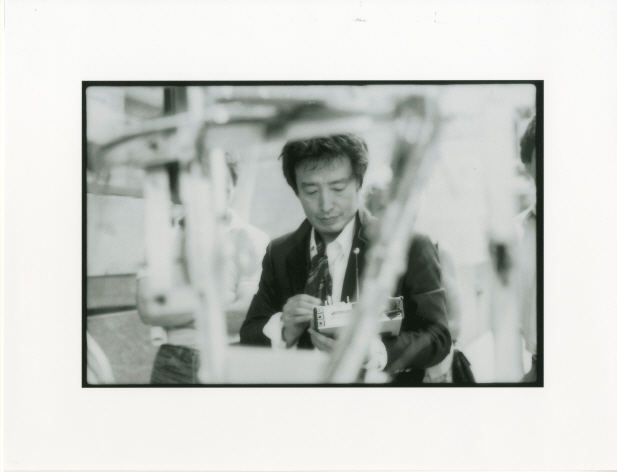
Paul Garrin, Nam June Paik testing the arm of Robot K-456 by remote control. 1982, Paul Garrin Collection, Nam June Paik Archive, Courtesy of Nam June Paik Art Center
One of the historic performances conceived by Nam June Paik, Robot Opera (1965), marked a pivotal moment in which robots and humans came together, embracing music and technology within the context of visual art. It was a pioneering attempt that proposed coexistence through artistic imagination, rather than portraying technology as a threat to humanity.
On the occasion of the 20th anniversary of Nam June Paik’s passing, the Nam June Paik Art Center presents commemorative performances by two artists who inherit and reinterpret the artistic spirit Paik articulated through Robot Opera. Through these performances, the Art Center seeks to honor Paik by extending his ideas into the present-day landscape of art and technology.
The two works presented in this program are both AI-based artworks, each expanding Paik’s thinking in distinct ways within today’s artistic and technological environment. Kwon Byungjun stages a robot play in the form of a traditional open-air theater, depicting an encounter between a fragile robot born from a sound system and Robot K-456. Appearing in this performance, Robot K-456 has been fully restored, with all of its movement functions—including walking with arms and legs, greeting, defecating, and speaking—successfully revived. This occasion marks the first public presentation of the robot’s fully restored movements, making it a particularly significant moment.
Kim EunJun begins from the fact that Paik named Robot K-456 after Mozart’s Köchel number K.456, drawing inspiration from the corresponding piano concerto. Through this musical reference, Kim translates Paik’s artistic vision into a sound performance. The scene in which irregular electronic sounds—composed and performed by Kim himself—intertwine with chamber music allows audiences to experience aurally the presence of Robot K-456, a figure that once imagined the boundary between life and death and warned of an uncertain future.
Through Robot K-456, Nam June Paik dismantled the illusion of perfection associated with “advanced technology,” instead revealing the imperfections of human life through the robot’s repeated trials and errors. In contemporary society in 2026, artificial intelligence—one of the most prominent technological trends—has deeply permeated everyday life by blurring the boundary between humans and technology, while simultaneously provoking confusion and fear.
AI Robot Opera